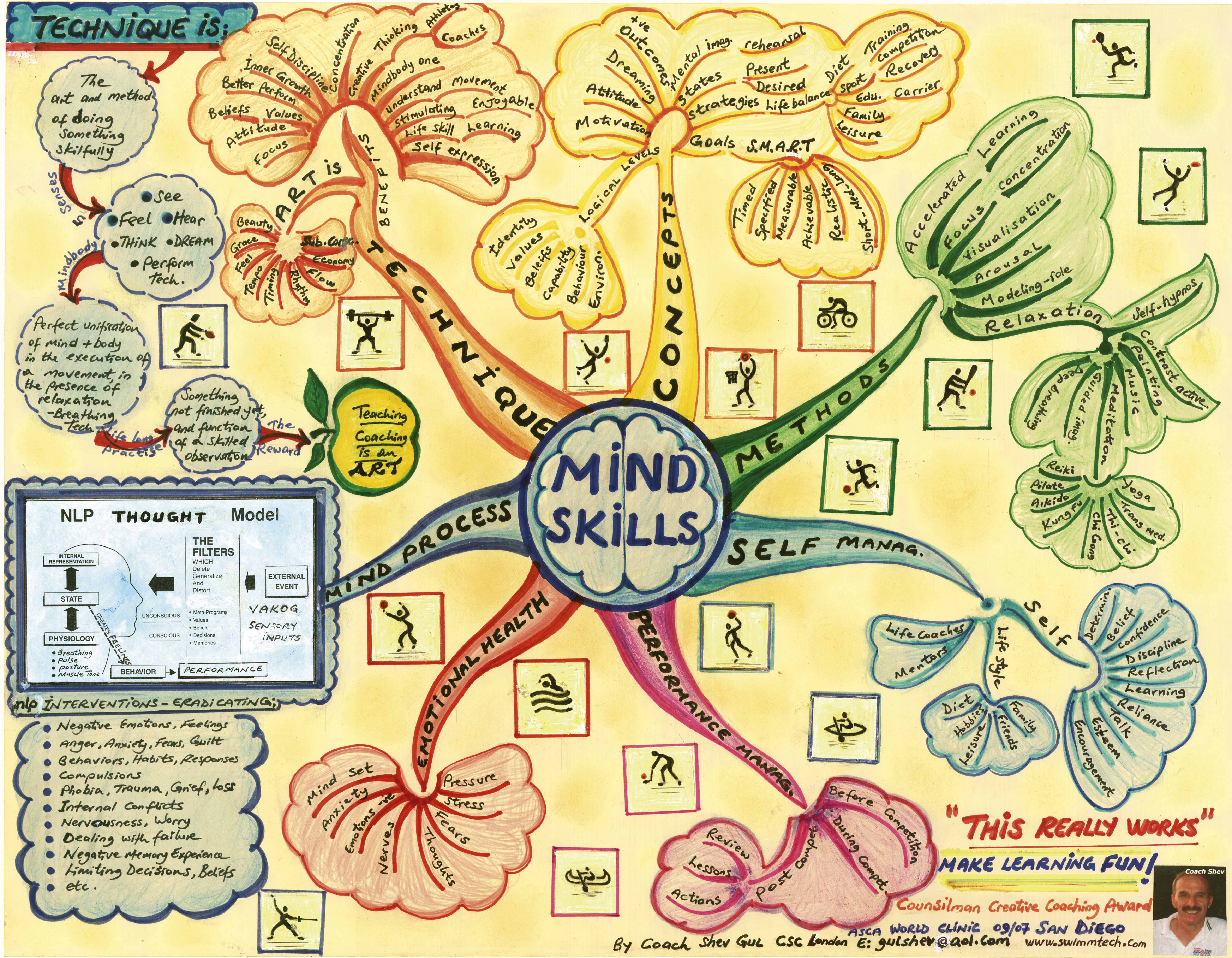
 From http://pkab.files.wordpress.com/2009/03/mind-skills-mind-map.jpg
Chapter 4. Conceptualizing Content
I think in this chapter the author of this book introduces the various concepts of conceptualizing content, so I just cite the conception on this blog. I will keep these conceptions in mind and then use them when I make my curriculum.
What does it mean to conceptualize content?
The process of conceptualizing content is a multifaceted one which involves thinking about what you want your students to learn in the course, given who they are, their needs, and the purpose of the course, making decisions about what to include and emphasize and what to drop, and organizing the content in a way that will help you to see the relationship among various elements so that you can make decisions about objectives, materials, sequence and evaluation (Graves, Designing Language Courses, 2000, p.37).
What makes up the content of language learning?
Three of Stern’s concepts (1992)
1. Language
1) linguistic skills - a structural syllabus or a formal syllabus
This consists of pronunciation, grammar, and vocabulary or lexicon.
2) Situations - a situational syllabus
Situations are the contexts in which one uses language. They typically include places where one transacts business, or places where one interacts with others.
3) topics or themes – A topical syllabus or a thematic syllabus
Topics are what the language is used to talk or write about. Topics and themes are often used interchangeably. The differences are that themes are broader relative to topics, although topics can be very broad, and that a theme may tie a group of topics together.
4) communicative functions - A functional syllabus
The purposes for which one uses language are called language functions such as persuading, expressing preference, and apologizing. Functions were initially paired with notions, and notions include concepts such as quantity, distance, smell, and texture.
5) Competencies - A competency-based syllabus
Competencies unite situations, linguistic skills, and functions. Competencies are an attractive way to conceptualize content because the elements can be specified and their achievement can be measured. Competency-based syllabuses are particularly popular in contexts where the sponsor or funder wants to see measurable results.
6) Tasks - A task-based syllabus
A simple definition is interactions whose purpose is to get something done. Tasks were seen as a way to promote classroom learning that focuses on the process of using language rather than language products, and on meaning as apposed to form.
A task-based syllabus is in the family of process syllabuses, which are those in which there is no predetermined content or outcomes for the course.
7) Contents - a content-based syllabus
Content is subject matter other than language itself. Courses in which students learn another subject (content) such as history or math or computer science through the L2 are organized around a content-based syllabus.
8) Four skills: speaking, listening, reading, and writing – A skills-based syllabus
The four skills are the channels or modes for using and understanding the language, and they are called the macro skills of language. Conceptualizing language as discourse means moving beyond language at the sentence level, and beyond inventories of functions and learned dialogues.
9) Genre
Language at the discourse level can also be viewed in terms of genre, communicative events or whole texts which accomplish certain purposes within a social context.
2. Learning and the learner
1) affective goals
are concerned with the learners’ attitudes toward themselves, learning, and the target language and culture.
2) interpersonal skills
involve how one interacts with others to promote learning.
3) learning strategies
focus explicitly on how one learns. They are the cognitive and metacognitive strategies we use to learn effectively and efficiently.
3. Social context
1) sociolinguistic skills
involve choosing and using the appropriate language and extralinguistic behavior for the setting, the purpose, the role and relationship.
2) sociocultural skills
involve understanding cultural aspects of identity, values, norms, and customs such as those underlying kinship relationships, expectations of men and women, or gift-giving. Such understanding enables us to interpret explicit and implicit messages and behave and speak in a culturally appropriate way.
3) sociopolitical skills
involve learning to think critically and take action for effective change in order to participate effectively in one’s community. Sociopolitical skills also involve learning to be critically aware of how both spoken and written language are used to help or hinder a given social group.
References:Graves, K. (2000). Designing Language Courses: A Guide For Teachers. Heinle: Boston, MA.Antoaneta Bonev. (2008). Module 4 content.ppt. Retrieved from http://blackboard.csusb.edu/webapps/portal/frameset.jsp?tab=courses&url=/bin/common/course.pl?course_id=_38168_1

Good understanding of the reading material, Ji Hae. You also have given a fine example of an image credit in your blog. Thank you.
ReplyDeleteThank your for your cheering comments! :)
ReplyDelete